
Behind the Documents: How America Was Built, Revised, and Reimagined


History is often remembered as something fixed. A finished page. A sealed moment. A date we circle and move on from.
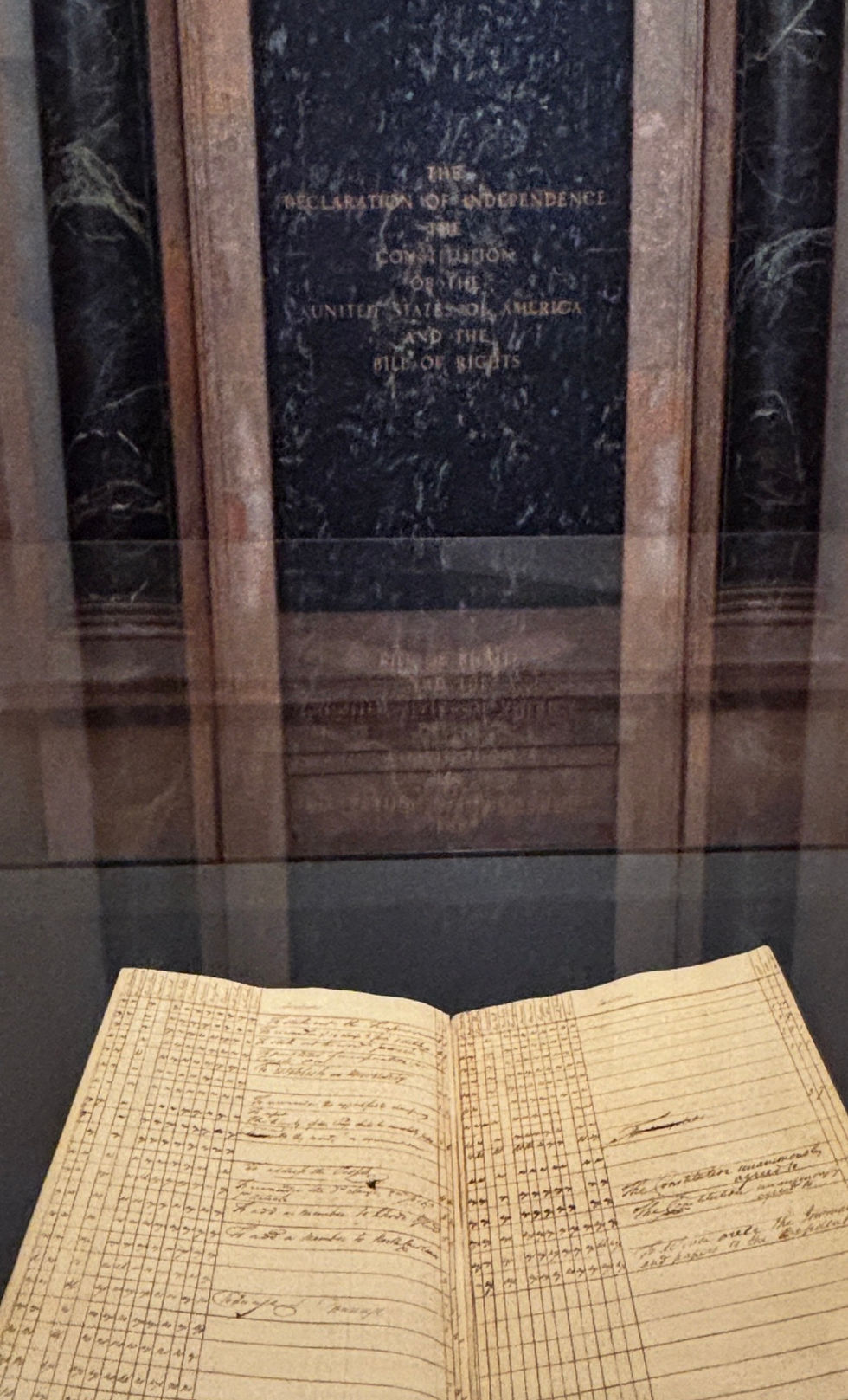
But standing in front of the documents now on view at the Museum of Miami, that idea starts to shift with their current exhibit, Freedom Plane National Tour: Documents That Forged A Nation : Celebrating America’s 250th Anniversary
Within this exhibit, you're not just getting a glimpse at history. what you see instead is something more human.
Scratch marks. Crossed-out lines. Handwritten edits layered over printed text. Pages that reveal not certainty, but negotiation. The process.
It is truly history in motion.

The documents featured in this limited-time exhibition capture a defining moment in American history, when delegates gathered in 1787 to shape a new system of government.
But what the records make clear is that nothing about that process was immediate or unanimous. It was built through disagreement, revision, and compromise.
Some states participated fully. Others did not participate at all. Votes were recorded in uneven ways. Ideas shifted between drafts. Text was rewritten in real time as delegates debated what kind of nation they were trying to create. And much of what became the

United States Constitution was created in secrecy, during meetings where delegates were instructed not to share details of what was being debated.
Because of that, these surviving documents carry an even greater weight. They are among the few records that reveal how ideas were tested, revised, and ultimately shaped into governing structure. Even the voting records reveal tension and absence, including states that refused to participate and others that could not fully agree internally.
What really stood out for me with this exhibit though traces the evolution of what would become the Bill of Rights.What many recognize today as the first ten amendments began as a much larger set of proposals. The House passed seventeen amendments. The Senate refined them down to twelve. By 1791, ten were ultimately ratified by enough states to become part of the Constitution.

But even the structure we now recognize carries a hidden complexity.
The amendment we know today as the First Amendment, protecting freedoms of speech, religion, and the press, was originally listed third in the sequence. Other proposed amendments, including those related to representation and congressional pay, did not initially pass at all. One of those ideas would resurface more than two centuries later, becoming the 27th Amendment after renewed public attention and a sustained push across state legislatures.
While these founding documents established a framework for governance, they did not define the full scope of who would ultimately be shaped by, or included within, that framework. Over time, that meaning has continued to expand through the efforts of generations who engaged with, challenged, and redefined the principles laid out in those early texts.
Black Americans, Indigenous communities, immigrant groups, and other historically marginalized communities have all played essential roles in expanding the meaning of rights, representation, and belonging in the United States. From Reconstruction to the Civil Rights Movement, from immigration waves to ongoing cultural transformation, the story of American democracy has continued to evolve far beyond its original draft...but not because the foundation changed on its own; because people insisted that it should grow.
Miami is one of the clearest places to see that ongoing evolution in real time. It's a city shaped by movement and migration. As Natalia Crujeiras, Museum of Miami’s CEO and Executive Director states, "Miami is one of the most diverse cities in our country. We have residents come from all over the world and either they, their parents or their grandparents came to Miami seeking freedom, seeking opportunity and believing in the promise of America." This is a place where Black Southern families, Caribbean communities, Latin American immigrants, and global cultures have each contributed to its identity.
In that way, Miami reflects something essential about the documents on display: the idea that nations are never finished. They are continually rewritten through the lives of the people who inhabit them.
So, Miami, I encourage you to visit this once-in-a-lifetime exhibition. It's not only about the past. It's about the long arc of how ideas travel, change, and expand as they are carried forward by new generations.

Freedom Plane National Tour: Documents That Forged a Nation
Through Jul 05, 2026
Thu-Sun: Noon - 5 PM
CLICK HERE FOR DETAILS


Comments